


en
en v
Phone
Cart0 Tickets
Total: 0
Account
Calendar
Search
Menu

Dido and Aeneas

VenueTeatro alla Scala Milano Tourist Packages
CalendarTue 26 Oct 2027 - Tue 16 Nov 2027
Synopsis/Details


The first great masterpiece of English opera is set in a girls’ boarding school in London in the 1680s. Purcell reworks, in a highly personal manner, the experiences of Venetian and French opera, achieving an entirely new result. Nahum Tate’s libretto reinterprets Virgil, combining the story of the love between Æneas, fleeing from Troy, and Dido, Queen of Carthage, with the grotesque interventions of witches. When Æneas abandons her to fulfil his mission, Dido takes her own life, addressing to her sister Belinda a farewell that remains among the most moving pages in the history of musical theatre. The difficult task of rendering the complex forms of English Baroque theatre in contemporary terms is often entrusted to artists capable of combining choreographic and directorial talent: in this case Marcos Morau, who thus makes his debut at the Piermarini. Conducting is Gianluca Capuano, who is exceptionally at ease in the ever-changing forms of pre-classical musical theatre. Emily D’Angelo sings the role of Dido, Alessio Arduini appears as Æneas, and Carlo Vistoli performs the Witch.


Synopsis

Act 1

Dido's court

The opera opens with Dido in her court with her attendants. Belinda is trying to cheer Dido up, but Dido is full of sorrow, saying 'Peace and I are strangers grown'. Belinda believes the source of this grief to be the Trojan Aeneas, and suggests that Carthage's troubles could be resolved by a marriage between the two. Dido and Belinda talk for a time: Dido fears that her love will make her a weak monarch, but Belinda and the Second Woman reassure her that "The hero loves as well." Aeneas enters the court, and is at first received coldly by Dido, but she eventually accepts his proposal of marriage.


Act 2

Scene 1: The cave of the Sorceress

The Sorceress/Sorcerer is plotting the destruction of Carthage and its queen, and summons companions to help with evil plans. The plan is to send her "trusted elf" disguised as Mercury, someone to whom Aeneas will surely listen, to tempt him to leave Dido and sail to Italy. This would leave Dido heartbroken, and she would surely die. The chorus join in with terrible laughter, and the Enchantresses decide to conjure up a storm to make Dido and her train leave the grove and return to the palace. When the spell is prepared, the witches vanish in a thunderclap.

Scene 2: A grove during the middle of a hunt

Dido and Aeneas are accompanied by their train. They stop at the grove to take in its beauty. A lot of action is taking place, with attendants carrying goods from the hunt and possibly a picnic in progress, Dido and Aeneas forming the focus of all the activity. This ceases when Dido hears distant thunder, prompting Belinda to tell the servants to prepare for a return to shelter as soon as possible. As every other character leaves the stage, Aeneas is stopped by the Sorceress's elf, who is disguised as Mercury. This pretend Mercury brings the "command of Jove" that Aeneas is to wait no longer in beginning his task of creating a new Troy on Latin soil. Aeneas consents to the wishes of what he believes are the gods, but is heart-broken that he will have to leave Dido. He then goes off-stage to prepare for his departure from Carthage.


Act 3

The harbour at Carthage

Preparations are being made for the departure of the Trojan fleet. The sailors sing a song, which is followed shortly by the Sorceress and her companions' sudden appearance. The group is pleased at how well their plan has worked, and the Sorceress sings a solo describing her further plans for the destruction of Aeneas "on the ocean". All the characters begin to clear the stage after a dance in three sections, and then disperse.

The palace

Dido and Belinda enter, shocked at Aeneas' disappearance. Dido is distraught and Belinda comforts her. Suddenly Aeneas returns, but Dido is full of fear before Aeneas speaks, and his words only serve to confirm her suspicions. She derides his reasons for leaving, and even when Aeneas says he will defy the gods and not leave Carthage, Dido rejects him for having once thought of leaving her. After Dido forces Aeneas to leave, she states that "Death must come when he is gone." The opera and Dido's life both slowly come to a conclusion, as the Queen of Carthage sings her last aria, "When I am laid in Earth", also known as "Dido's Lament." The chorus and orchestra then conclude the opera once Dido is dead by ordering the "cupids to scatter roses on her tomb, soft and gentle as her heart. Keep here your watch, and never, never part."

Cast

OPERA  DIDO AND ÆNEAS  Henry Purcell


Opera in three acts

Libretto by Nahum Tate

Orchestra and Chorus of Teatro alla Scala

Teatro alla Scala New Production


Cast

Conductor: GIANLUCA CAPUANO

Staging and choreography: MARCOS MORAU

Sets: MAX GLAENZEL

Costumes: SILVIA DELAGNEAU

Dramaturgy: ROBERTO FRATINI


Dido: Emily D'Angelo

Æneas: Alessio Arduini

Belinda: Mélissa Petit

Second woman: Loriana Castellano

Sorceress: Carlo Vistoli

First witch: Jiayu Jin

Second witch: Valeria Girardello

First sailor: Massimo Altieri

Venue
Teatro alla Scala Milano Tourist Packages

Official Reseller

RM Europa Ticket GmbH is an officially accredited ticket reseller of/by Fondazione Teatro alla Scala di Milano. 

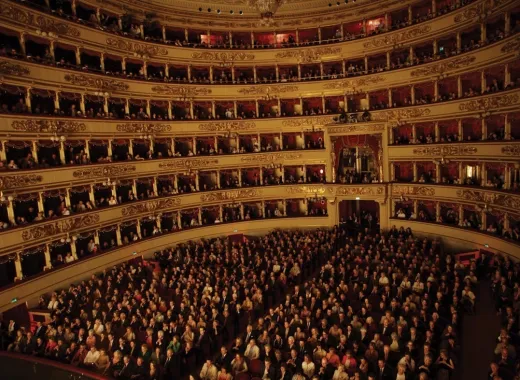
La Scala (abbreviation in Italian language for the official name Teatro alla Scala) is a world-renowned opera house in Milan, Italy. The theatre was inaugurated on 3 August 1778 and was originally known as the New Royal-Ducal Theatre alla Scala (Nuovo Regio Ducale Teatro alla Scala). The premiere performance was Antonio Salieri's Europa riconosciuta.

Most of Italy's greatest operatic artists, and many of the finest singers from around the world, have appeared at La Scala during the past 200 years. Today, the theatre is still recognised as one of the leading opera and ballet theatres in the world and is home to the La Scala Theatre Chorus, La Scala Theatre Ballet and La Scala Theatre Orchestra. The theatre also has an associate school, known as the La Scala Theatre Academy (Italian: Accademia Teatro alla Scala), which offers professional training in music, dance, stage craft and stage management.
 

La Scala's season traditionally opens on 7 December, Saint Ambrose's Day, the feast day of Milan's patron saint. All performances must end before midnight, and long operas start earlier in the evening when necessary.

The Museo Teatrale alla Scala (La Scala Theatre Museum), accessible from the theatre's foyer and a part of the house, contains a collection of paintings, drafts, statues, costumes, and other documents regarding La Scala's and opera history in general. La Scala also hosts the Accademia d'Arti e Mestieri dello Spettacolo (Academy for the Performing Arts). Its goal is to train a new generation of young musicians, technical staff, and dancers (at the Scuola di Ballo del Teatro alla Scala, one of the Academy's divisions).

BAR AND RESTAURANT

La Scala has several foyer bars: one in the stalls foyer, two bars in the “Arturo Toscanini” boxes foyer (third floor of boxes) and two in the Second Gallery foyer. Bars open before curtain-up and in the intervals.

Food and drink may not be consumed outside the foyers. Food and drink is not permitted in the auditorium, in boxes or galleries.

Next to La Scala’s main entrance you will find the Ristorante Teatro alla Scala “Il Marchesino”, run by celebrated Italian chef Gualtiero Marchesi. The perfect place to enjoy an aperitif or dinner before or after the show, the restaurant is open Monday to Saturday from morning to late evening. Booking recommended.


LA SCALA SHOP 

The La Scala Shop is located inside the opera house and can be accessed from the street and from the stalls foyer during performances. The La Scala Shop sells CDs, DVDs, books and other La Scala-related items.

 

Accomodation

Buy now

Gift vouchers

Gift someone an unforgettable night at the opera.
Choose a gift coupon and let them pick the performance they love—music, drama, and world-class artistry, all in one elegant experience.
Milano Opera Tickets
Facebook
Payment
Ticket search
Google Play
App Store
© 2026 RM EUROPA TICKET GmbH
Whatsapp